
Beekeeping knowledge
Practical knowledge for the work at the colony – from the first cleansing flight to the winter treatment in December.
Beekeeping knowledge
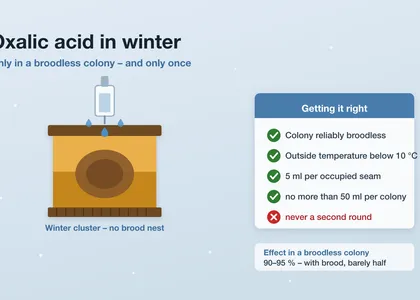
Oxalic acid in winter: timing, dosage, methods
The winter treatment is your last chance to bring the mite load down before spring. It stands or falls on two conditions: the colony must be broodles…
Beekeeping knowledge
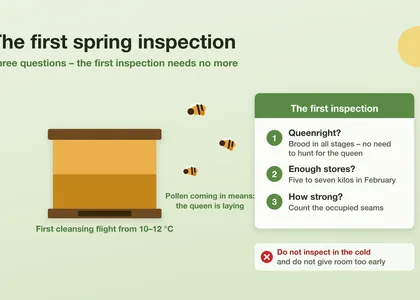
The first spring inspection: three questions, no more
The first inspection tells you which colonies will get away. Open too early or search too thoroughly and you do more damage than you gain in knowledg…
Beekeeping knowledge
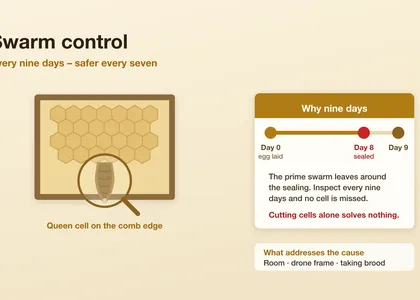
Swarm control: the nine-day cycle and what actually works
Cut out queen cells and nothing else, and you are fighting the symptom – you will still lose a swarm eventually. The nine-day cycle buys you the wind…
Beekeeping knowledge
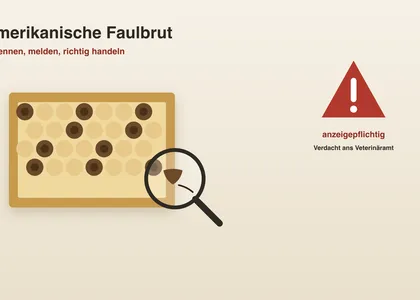
Recognising American foulbrood and acting correctly
American foulbrood is one of the most feared bee diseases – and notifiable. We show how to recognise it early, why even the suspicion must be reporte…
Beekeeping knowledge
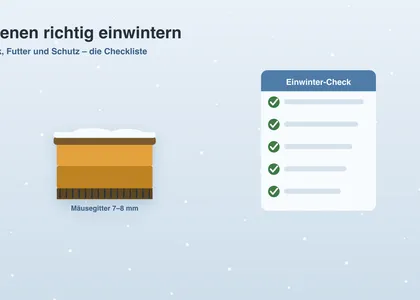
Wintering bees correctly: the checklist for healthy colonies
Winter is decided in late summer. Whoever sets the course right now – strong colony, enough feed, little varroa and good protection – brings their be…
Beekeeping knowledge
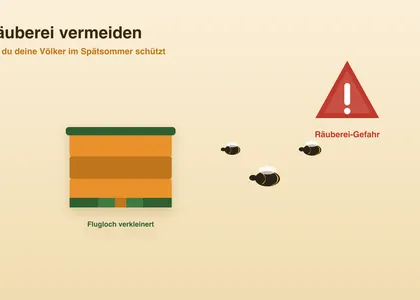
Preventing robbing: protecting your colonies in late summer
When the flow dries up, the apiary becomes dangerous: robbing can destroy whole colonies in late summer. We show how it arises, how to prevent it rel…
Beekeeping knowledge
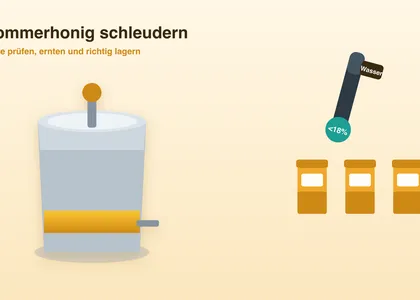
Extracting summer honey: checking ripeness, harvesting and storing correctly
Summer brings the second big harvest. For your honey to keep well and stay creamy, timing and storage are what count. We show you how to check ripene…
Beekeeping knowledge
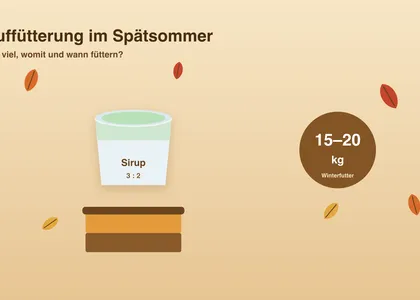
Late-summer feeding: how much winter store bees need
After harvest and varroa treatment comes feeding – the basis for a good winter. We clarify in detail how much winter store a colony needs, which suga…
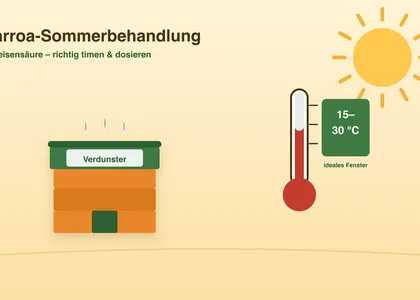
Beekeeping knowledge
Varroa summer treatment 2026: using formic acid correctly
After the last honey harvest, the most important varroa treatment of the year begins. We show you in detail how to proceed in summer with formic acid…

Beekeeping knowledge
Digital hive record vs. paper: what is worth it for beekeepers?
Hive record on paper or in an app? Both work – but they differ clearly in effort, overview and analysis. We compare strengths and weaknesses honestly…
What you will find here
The articles in this section follow the beekeeping year. They answer questions that come round every season and rest on what holds up in practice rather than on what reads well.
By season
Spring. The first inspection decides which colonies get away – and most of it can be read without opening the hive. From April, swarm control follows on a nine-day cycle.
Summer. After the harvest comes varroa treatment: timing formic acid, extracting summer honey and preventing robbing as the flow dries up.
Late summer and autumn. Feeding and wintering settle how the colony comes into spring.
Winter. In the broodless colony it is time for the oxalic acid treatment – the last chance to bring the mite load down before spring.
Rules and records
Anyone selling honey records their treatments. What that means in practice, and what has had to go on the label since June 2026 under the new origin labelling, is covered in separate articles. The exact obligations depend on the country you keep bees in.
Calculate instead of guess
Several topics come with free calculators: the varroa indicator projects a mite drop onto the colony, the water content calculator places your refractometer reading, and the winter feed calculator tells you how much sugar you need.