
Beekeeping knowledge
Swarm control: the nine-day cycle and what actually works
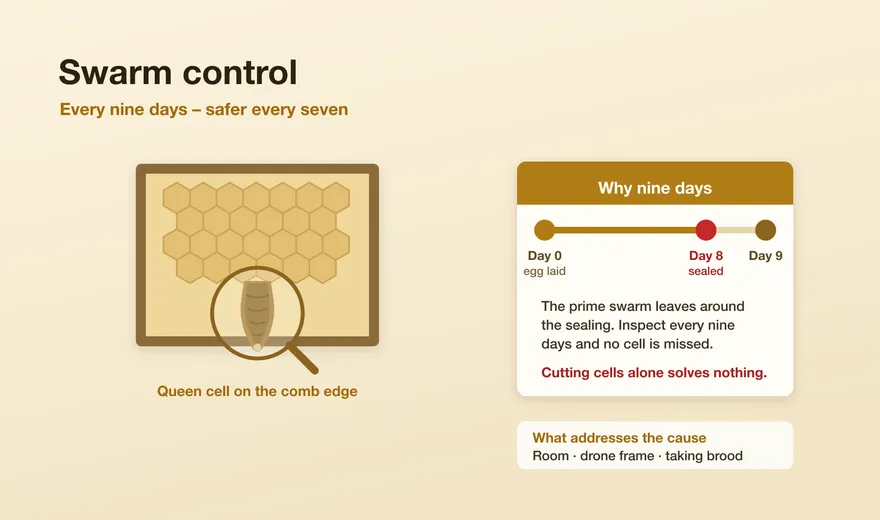
Cut out queen cells and nothing else, and you are fighting the symptom – you will still lose a swarm eventually. The nine-day cycle buys you the window; the real work is something else.
A swarm that gets away costs you half the colony, the crop and, in the worst case, your standing with the neighbours. Yet a swarm announces itself for weeks. You only have to look at the right moment – and understand that looking is not enough.
Why nine days exactly
The number does not come from tradition but from the development of a queen. A queen cup with an egg in it becomes a sealed queen cell on the eighth day after laying. And shortly before or after that sealing, the prime swarm leaves with the old queen.
Inspect every nine days and no cell can seal unseen – there is no complete cell cycle between two visits. Inspect every ten or twelve days and exactly that can happen. If you want a margin, go to seven days: it forgives one rained-out inspection.
Depending on region and weather the swarming season runs from mid-April to around midsummer. After that the impulse fades noticeably.
How to spot the swarming impulse
Queen cups with eggs in them. Colonies build empty cups all year round – those mean nothing. What counts is whether there is an egg or larva inside. From then the clock is running.
The colony sits thick. Bees hang in clusters under the combs and on the landing board without it being hot.
The drone frame is left alone. A colony in building mode draws a drone frame out quickly. If it is suddenly ignored, the building impulse has turned into the swarming impulse.
Plenty of drone brood belongs to the picture – a swarm needs drones to mate its new queen.
Inspecting properly
Queen cells sit by preference along the bottom edge and the sides of the combs, often shadowed by clinging bees. Glancing at the combs is therefore not enough. Lift every brood comb and look at both faces and the edges. One missed cell makes the whole inspection worthless.
Put the inspection in the diary as a fixed date, not as "when I get round to it". Nine days become twelve fast.
Why cutting cells alone fails
You cut out every cell, and nine days later there are new ones. That is not a failure on your part – the colony has made a decision and the trigger is still there. You tie yourself to a rhythm you have to keep until the end of June without missing a single date. Sooner or later there is rain, a weekend, a trip. Then the swarm is gone.
Cutting cells buys time. It is not a solution.
What addresses the cause
Give room before it gets tight. The commonest trigger is plain lack of space in the brood nest. Put the super on in good time instead of waiting until the colony "needs" it. A colony suffocating in its own stores in April starts thinking about leaving in May.
Give a drone frame. A drone frame in the brood chamber channels the building impulse somewhere useful. As a bonus the drone brood is a mite trap: cutting it out takes varroa out of the colony. Two jobs, one frame.
Take brood out. Lift a sealed brood comb with the bees on it and make a nucleus from it. You reduce the pressure, gain a new colony and remove varroa at the same time. This is the intervention with the best ratio of effort to effect.
An artificial swarm or a split for colonies that will not let go despite everything. You separate the queen from the brood and take away the basis for swarming.
What does not help
Clipping the queen's wing prevents no swarming impulse. The colony swarms anyway; the queen simply falls into the grass in front of the hive. You lose her and still have the problem inside.
A queen excluder under the hive does not hold a swarm either in the long run – it delays it.
Do not keep the rhythm in your head
With three colonies you can. With twelve across three sites you cannot. What you need is the state of play per colony: when you last looked, what you found, what you did. The next date follows from that by itself.
Keep that up over a season and you also spot the swarmy queens among your stock – and know which colony not to raise from when you requeen. Why this regularly fails on paper is covered in our comparison of digital hive records and paper.
Nine days become twelve fast
Record per colony when you inspected and what you found – the next date follows by itself. Over a season you also see which queens tend to swarm.
Try the hive record for freeFrequently Asked Questions
How often do I have to inspect for swarming?
Every nine days at most, every seven to be safe. A queen cell is sealed on the eighth day after the egg was laid, and the prime swarm leaves shortly afterwards. With a longer interval a cell can seal without you seeing it.
Is cutting out the queen cells enough?
No. The colony builds new ones as long as the trigger remains – usually lack of space in the brood nest. Cutting cells buys time but solves nothing. What works is giving room, a drone frame, taking brood out to a nucleus, or making an artificial swarm.
When is the swarming season over?
The impulse fades noticeably around midsummer, depending on region and weather. Until then you stay on the rhythm. A colony still charging queen cups in July usually has a different problem – an ageing queen, for instance.
 Organic cotton beekeeper T-shirt “The Dance Language”