
Beekeeping knowledge
Varroa summer treatment 2026: using formic acid correctly
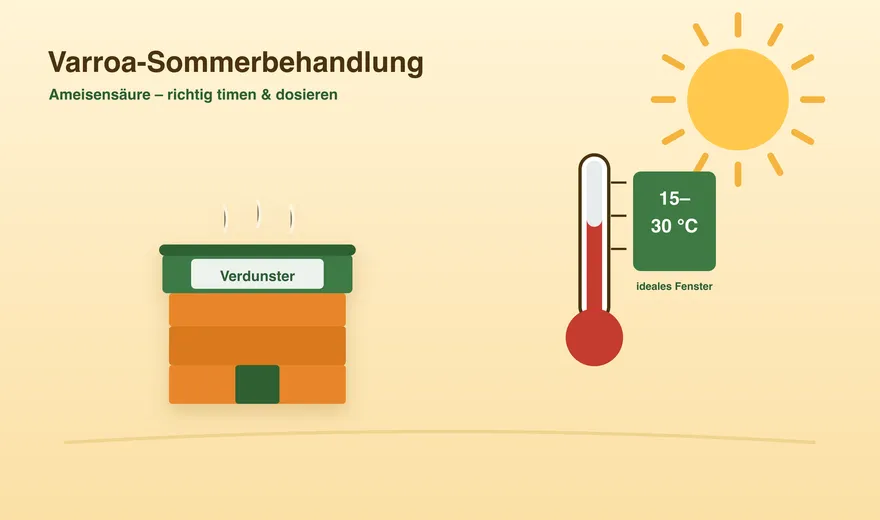
After the last honey harvest, the most important varroa treatment of the year begins. We show you in detail how to proceed in summer with formic acid – from the right timing and temperature and method to success control and residual treatment.
There are few dates in beekeeping that decide success or failure as much as the varroa summer treatment. Anyone who does not get the mite under control now risks damaged winter bees, viral diseases and, in the worst case, the collapse of the colony in winter. So the clear rule is: right after spinning the last harvest – usually mid to late July – it starts. Every day you wait works for the mite.
Measure first, then treat
Before you reach for the acid, get a picture of the infestation. Two proven methods: with the mite drop count you insert the board and count the natural daily mite drop after a few days. With the powdered sugar method you roll a sample of bees in powdered sugar and count the fallen mites. Both tell you how urgent the situation is – and later provide the comparison value to judge the treatment success. Without measuring, you treat blind.
Why formic acid of all things?
In summer, formic acid is the means of choice – for a simple but decisive reason: it is the only common acid that also acts inside the capped brood. And that is exactly where most mites hide in summer, under the cell cappings. The acid evaporates in the colony and kills the mites via their airways. Other agents such as oxalic acid only reach the mites on the bees and would be ineffective now, with lots of brood.
Temperature is the key
Formic acid works through evaporation – and that depends directly on the weather. The ideal window is around 15–30 °C. If it is too cold, too little acid evaporates and the mites survive. If it is too hot, too much evaporates at once, which can harm the bees and the open brood and, in extreme cases, even endanger the queen. Keep an eye on the forecast and start treatment on days with moderate temperatures. Some evaporators with fleece additionally compensate for temperature fluctuations.
Methods and dosing
There are several proven ways to apply it, and the choice is partly a matter of taste:
- Evaporators such as the Nassenheider or the Liebig dispenser release the acid in a controlled way over several days.
- The sponge cloth method is cheap and simple but works as a short, powerful burst and must be dosed precisely.
- Ready-made gel strips simplify application but are more expensive.
The dosing depends on hive type, colony size and the acid's concentration – stick strictly to the instructions of the respective product and evaporator. Two treatment rounds a few weeks apart are common, to effectively curb mite reproduction in July and August and also catch the mites that have emerged from the brood in the meantime.
Safety first: formic acid is corrosive and its vapours irritate the airways. Always wear acid-resistant gloves and safety goggles, work outdoors and decant only in a sheltered spot.
Check the success – and re-treat if needed
After each treatment, the board shows how many mites have fallen. Compare the value with your baseline measurement. If the infestation stays high despite treatment, you have to re-treat – better once too often than sending a weakened colony into winter. Follow the manufacturer's instructions and the current recommendations of your bee institute, as the optimal timings and amounts can vary regionally.
Don't forget the residual treatment
A common mistake is to sit back after the summer treatment. The summer treatment alone is usually not enough to bring the colonies cleanly into winter. The final step is the residual treatment in the broodless state in late autumn or winter – with oxalic acid for trickling, spraying or as strips. Only the combination of timely summer treatment and consistent residual treatment brings your colonies healthy and strong into the next spring.
Document inspections without thinking about it
Record date, product, amount and the treated colonies right at the apiary. The basis for your treatment records builds itself as you go.
Start for freeFrequently Asked Questions
When is the right time for the varroa summer treatment?
Right after spinning the last honey harvest, usually mid to late July. Measure the infestation beforehand (mite drop count or powdered sugar).
What temperature does formic acid need?
The ideal window is around 15–30 °C. Too cold: too little evaporation and effect. Too hot: too strong evaporation with risk to bees and brood.
Is the summer treatment alone enough?
Usually not. In the broodless state in late autumn/winter, the residual treatment with oxalic acid follows. Only the combination brings the colonies cleanly into winter.
 Organic cotton beekeeper T-shirt “The Dance Language”