Beekeeping knowledge
New honey labelling from 14 June 2026: origin must appear on the label
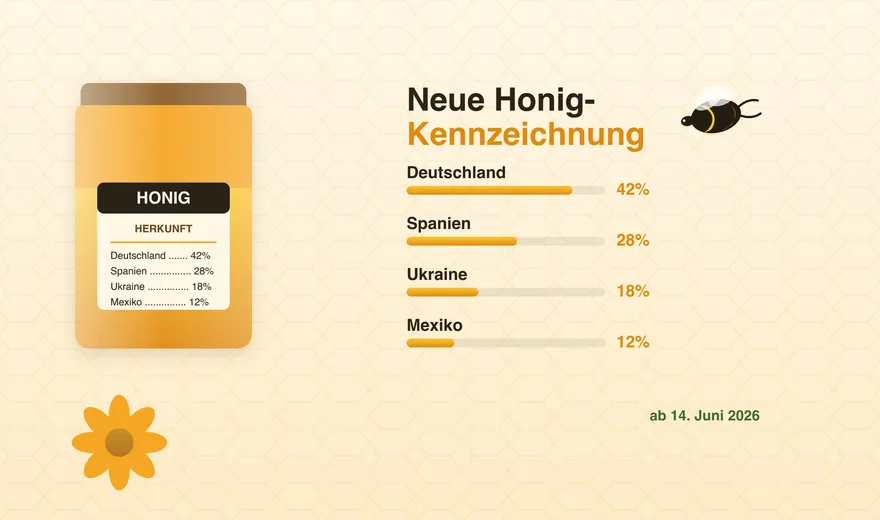
From 14 June 2026, new EU rules apply to honey labelling. For blended honey, every country of origin must now appear on the label with its percentage. We explain what changes – and for whom.
For more clarity on the honey jar: since 14 June 2026, new labelling requirements for honey apply across the entire EU. The basis is the revised EU Directive 2024/1438, the so-called "Breakfast Directive", which affects not only honey but also fruit juices, jams and milk products. Germany has transposed it into national law via an amendment to the honey regulation.
What changes for blended honey
The most important change concerns blended honeys – that is, honeys mixed together from several countries. For them, the following now applies:
- All countries of origin must be named on the label.
- The countries appear in descending order of their share.
- Each country is accompanied by its percentage share.
- The information must be clearly visible in the main field of vision.
The collective descriptions previously in use – such as "blend of EU honeys", "blend of non-EU honeys" or "blend of EU and non-EU honeys" – are thereby a thing of the past. For consumers this means considerably more transparency about where a honey really comes from.
Notably, Germany deliberately declined a possible exemption under which only the four largest countries of origin would have had to be named with a percentage. Here, therefore, the full listing of all countries applies. Incidentally, the term "filtered honey" is also dropped – it will legally be classified as baker's honey.
What this means for you as a beekeeper
For the vast majority of beekeeping operations in Germany, the fuss is smaller than the headlines suggest. Anyone who – like most hobby and commercial beekeepers – bottles and sells only their own honey from one country was already required to state the country of origin (usually simply "Germany"). Nothing changes about that.
The new rule only becomes relevant if you mix honeys of different countries of origin and sell them as blended honey. Then you must in future list each country with its percentage share. In practice this mainly affects larger bottlers and the trade in imported honey – rarely classic direct marketing.
Note the transition period
There is a generous transitional arrangement: honeys that were bottled and labelled before 14 June 2026 may still be sold off. Stock with the old labelling therefore does not have to be pulled from the shelf. Everything newly labelled after that date, however, must comply with the new requirements.
Our tip: check your labels in good time. If you only offer your own honey, you are usually already on the safe side. Anyone who blends or buys in should now adapt their ingredient and origin details to the new system.
Source
Directive (EU) 2024/1438 amending Directive 2001/110/EC relating to honey ("Breakfast Directive"); applicable from 14 June 2026. National transposition via the amendment of the German honey regulation. Information from the German Beekeepers' Association (Deutscher Imkerbund e. V.) and the Honey Association.
Document inspections without thinking about it
Record date, product, amount and the treated colonies right at the apiary. The basis for your treatment records builds itself as you go.
Start for freeFrequently Asked Questions
What changes from 14 June 2026 for honey labelling?
For blended honey, all countries of origin must appear on the label in descending order and with their percentage share, clearly visible. Collective statements such as "blend of EU and non-EU honeys" are no longer permitted.
As a beekeeper with my own honey, do I have to change anything?
Usually not. Anyone bottling their own honey from one country already had to state the country of origin (e.g. "Germany"). The new percentage rule only applies if you mix honeys from several countries.
Can I still use old labels?
Honey that was bottled and labelled before 14 June 2026 may still be sold off. Newly labelled stock, however, must comply with the new requirements.
 Organic cotton beekeeper T-shirt “The Dance Language”