
Beekeeping knowledge
Oxalic acid in winter: timing, dosage, methods
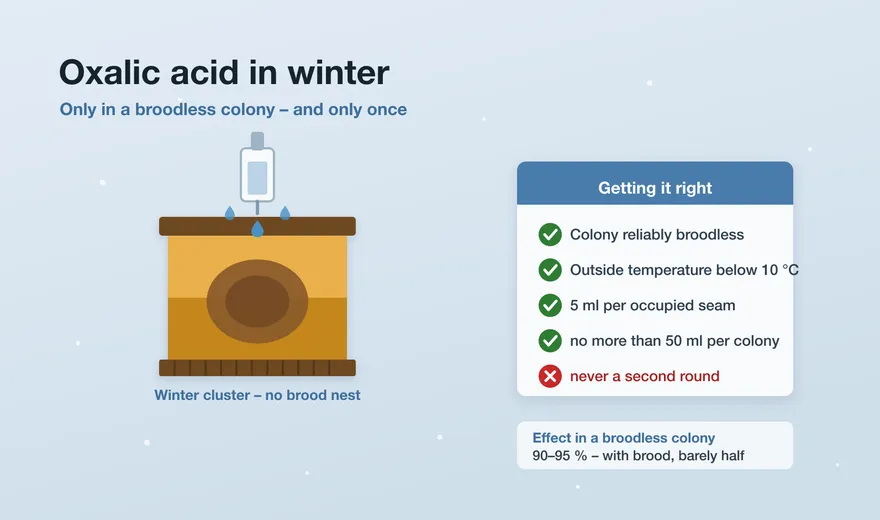
The winter treatment is your last chance to bring the mite load down before spring. It stands or falls on two conditions: the colony must be broodless, and you treat exactly once.
You treated in late summer, you fed in autumn – and still there are mites in your colonies in December. That is normal. The winter treatment in the broodless colony is the step that decides how your season starts. Put it off or get it wrong, and you carry a debt into spring.
Why broodlessness decides everything
Oxalic acid only reaches mites sitting openly on the bees. It does not penetrate capped brood cells. As long as your colony has brood, up to 80 per cent of the mites are out of reach – sealed in the cells, reproducing.
In a broodless colony that reverses: practically the entire mite population is riding on the bees. A single treatment then reaches 90 to 95 per cent. The same treatment in a colony with brood barely manages half – at the same cost to the bees.
When is the colony broodless?
The calendar will not tell you. Depending on weather, site and the origin of the queen, the broodless window falls somewhere between late November and late December – in mild winters some colonies never stop.
These will tell you:
- Debris on the tray: slide in the inspection board and look a few days later. Cappings in rows mean brood is emerging – the colony is not broodless yet.
- A look from below: with an open floor the shape of the cluster shows whether a brood nest is being kept warm.
- A brief check: lift one central comb on a mild day. Only if you must, and only briefly.
A longer cold spell helps the brood break along. If you used oxalic acid strips, you are working on a different principle – strips act over weeks and are precisely not dependent on broodlessness.
The three methods
Trickling is the standard winter method. You use a 3.5 per cent oxalic acid solution in sugar syrup – authorised products are made up according to their instructions. You trickle 5 ml per occupied seam, no more than 50 ml per colony, slowly into the gap between the bees. The solution should be lukewarm.
Spraying suits broodless artificial swarms and splits where you have the combs in hand anyway. In an overwintering colony it is not an option: you would have to take the cluster apart.
Vaporising (sublimation) delivers the acid as an aerosol. It works well and is gentle on the bees, but it demands an authorised product, the right device and serious respiratory protection. Oxalic acid vapour is not an irritant you wait out – it attacks the airways. Without a full mask and particulate filter the vaporiser stays in the shed.
Once, and only once
This is where most of the damage is done. Mites keep dropping for a fortnight after treatment – and it is tempting to think a second round could not hurt.
It does hurt. Repeated application damages the gut epithelium of the bees. You lose winter bees, which are precisely the ones that have to carry the colony into spring. The extra dead mites are no trade for that.
A heavy drop after treatment is not a reason to repeat. It is information for next season: your summer strategy was not enough.
Temperature and protection
Treat on a day below 10 °C, when the colony sits in a tight cluster – then little liquid reaches many bees. In hard frost work fast and keep the hive open as briefly as you can.
For yourself: acid-resistant gloves and eye protection, trickling included. Oxalic acid is not citric acid; it is corrosive and it is taken up through the skin. Made-up solution does not keep – mix only what you will use that day.
Check that it worked
Slide the tray back in and count the drop over one to two weeks. The bulk comes in the first few days. What you count tells you two things: whether the treatment landed, and how heavy the load was going into winter. Both belong with that colony, not on a scrap of paper.
To put the numbers in context, the varroa indicator converts a daily mite drop into an estimate of the infestation in the colony.
What has to be recorded
Every use of a veterinary medicine has to be recorded. Among other things you note the date, the product, the quantity and the colonies treated. Whoever writes that on a note in December with cold fingers will not find it again in spring.
What exactly is required depends on where you keep bees – in the EU the rules follow from veterinary medicines legislation, elsewhere from national law. Your bee inspector or beekeeping association will tell you what applies to you.
Put the winter treatment where it belongs
Date, product, quantity and the colonies treated – entered at the apiary, in frost and without a signal. Come spring you see per colony what happened in December.
Keep treatment records digitallyFrequently Asked Questions
When is the right time for the winter oxalic acid treatment?
As soon as the colony is broodless – usually between late November and late December, depending on weather and site. Check for broodlessness on the inspection tray rather than trusting a date. In a colony with brood, up to 80 per cent of the mites sit protected in capped cells and are never reached.
Can I trickle a second time if plenty of mites are still dropping?
No. Repeated application damages the gut epithelium of the bees and costs you winter bees. A heavy mite drop is not a reason for a second treatment; it is a sign that the summer treatment fell short.
Do I have to record the winter treatment?
Yes. Treatments with veterinary medicines have to be recorded – date, product, quantity and the colonies treated, among other things. The simplest way is to enter it at the hive rather than reconstruct it later.
 Organic cotton beekeeper T-shirt “The Dance Language”