
Beekeeping knowledge
Late-summer feeding: how much winter store bees need
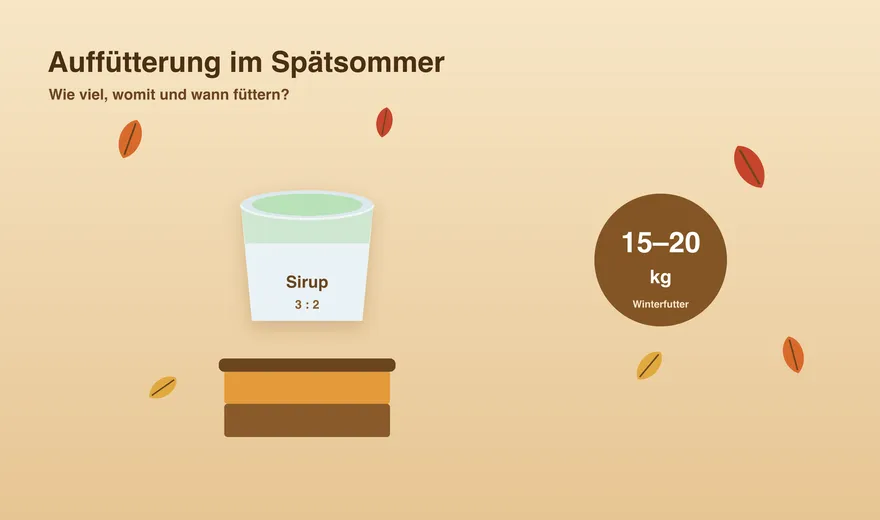
After harvest and varroa treatment comes feeding – the basis for a good winter. We clarify in detail how much winter store a colony needs, which sugar ratio fits, by when you should be done and how you avoid robbing and typical mistakes.
Work out how much feed you need
Enter the number of colonies and the store each one needs: the calculator adds up how much syrup or fondant you have to buy.
To the feed quantity calculatorAs soon as the honey is harvested and the first varroa treatment is done, feeding is due – the last big task of the bee year, and the one that decides the winter. Because you have harvested your own honey, the bees now lack their natural winter store. You have to replace this store with sugar feed, otherwise the colonies starve in the cold season. A well-filled, healthy colony is half the battle for a successful wintering.
How much winter store does a colony need?
The proven guide values are:
- Single-box wintered colonies: around 15 kg of winter store.
- Double-box colonies or large hives: around 18–20 kg.
The exact amount depends on hive type, colony strength, bee race and region – a colony in a rough upland location needs more reserve than one in a mild wine-growing climate. As a rule of thumb: better to feed a little generously than too tight. You can easily remove leftover feed in spring; you cannot get a starved colony back.
What to feed with?
Most common and cheapest is home-mixed sugar syrup in a 3:2 ratio – that is, 3 kg of household sugar to 2 litres of water. Dissolve the sugar fully in warm water and give the syrup hand-warm, not hot. If you prefer convenience, reach for ready-made invert-sugar syrups: they are ready to use and well accepted by the bees, but cost more. Fondant, on the other hand, is less suited to the main feeding – it is more for later top-ups or as an emergency ration in winter, when the bees can no longer process liquid feed.
When to feed?
On timing the rule is: not too early, but above all not too late. Give the main amount in August; you should be finished by mid-September at the latest. The reason lies in biology: the bees first have to move, thicken and cap the liquid feed in the combs – and they can only do that while they are sufficiently active and numerous. If you feed too late, the feed stays unprocessed, can ferment and is not reliably available in winter.
How to feed correctly – and avoid robbing
A few small moves decide between success and trouble:
- Feed in suitable portions: with double-box wintering you can quickly give larger amounts. With single-box wintering, smaller batches of about 5 litres are better, so the brood nest is not blocked with feed too early and winter-bee production is not slowed.
- Avoid robbing: feed in the evening when flight activity dies down, do not spill anything, and narrow the entrance of weak colonies. In late summer the forage is scarce – an open feeder otherwise attracts foreign bees and wasps, and robbing can ruin whole colonies.
- Use suitable feeders: feeder tray, feeder box or feeder bucket with a float so no bees drown.
Checking: is there enough inside?
Whether your colony is sufficiently supplied is easiest to check with the tilt test: you lift the hive slightly at the back and estimate from the weight how full it is – with a little practice a surprisingly reliable feel. In addition, a look at the feed rim above the brood nest shows how the reserves stand. Note which colony received how much. That way you keep track of all colonies and know in late winter where you may need to help out with fondant.
Document inspections without thinking about it
Record date, product, amount and the treated colonies right at the apiary. The basis for your treatment records builds itself as you go.
Start for freeFrequently Asked Questions
How much winter store does a colony need?
As a guide, around 15 kg for single-box and about 18–20 kg for double-box wintering or large hives. The exact amount depends on hive, colony strength and region.
Which sugar ratio for winter feed?
Common is sugar syrup 3:2 (3 kg sugar to 2 litres of water). Ready-made invert-sugar syrups are more convenient but more expensive. Fondant is more for later top-ups.
By when must feeding be finished?
Give the main amount in August, be finished by mid-September at the latest – while the bees can still move, thicken and cap the feed.
 Organic cotton beekeeper T-shirt “The Dance Language”