
Beekeeping knowledge
Extracting summer honey: checking ripeness, harvesting and storing correctly
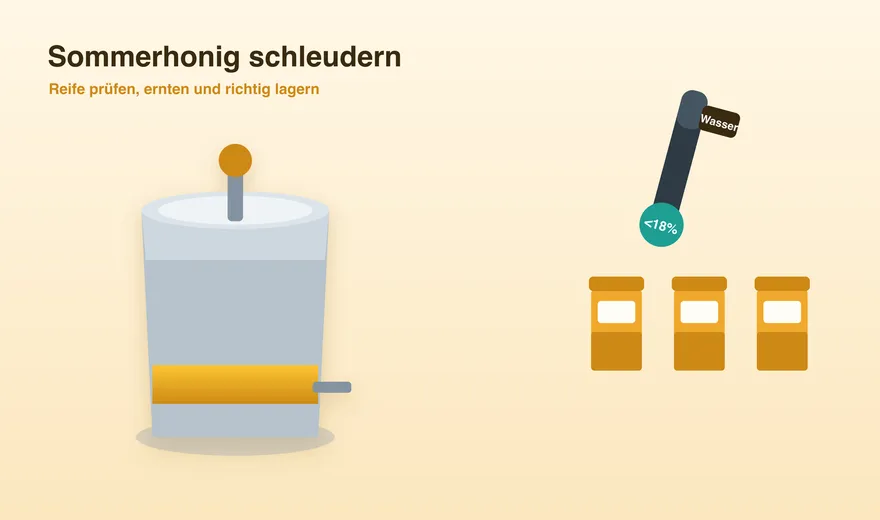
Summer brings the second big harvest. For your honey to keep well and stay creamy, timing and storage are what count. We show you how to check ripeness, extract cleanly and store the honey optimally.
Check the water content
Refractometer read? Enter the Brix or water value: the calculator corrects for temperature and tells you whether the honey is ready to extract.
To the water content calculatorAfter the spring flow, high summer brings the second big harvest – summer honey. It is often darker and stronger than spring honey. For your harvest to become a durable, high-quality jar of honey, three things matter: the right harvest time, clean work during extraction and the right storage. We go through all three in turn.
When is honey ready to extract?
The most common beginner mistake is harvesting too early. Honey is only ripe once the bees have dried it sufficiently and capped the cells. As a rule of thumb: at least two thirds of the comb should be capped. The decisive value, though, is the water content – it should be below 18 %. Honey marketed under the German Beekeepers' Association label may contain a maximum of 18 %. Above that, honey can ferment and become inedible.
Two simple methods help you judge: the splash test and the refractometer. For the splash test, hold the comb horizontally and jerk it downwards sharply. If nectar splashes out of the open cells, the honey is not yet ripe – then it is time to wait. More precise and reliable is the refractometer, which shows you the water content directly. For selling, this small device is definitely worth it.
Extracting step by step
Once the honey is ripe, it is time to harvest. Work on a warm day in a bee-proof, clean room – honey attracts bees and wasps magically. Uncap the combs with an uncapping fork or tray, place them in the extractor and start slowly at first so the combs do not break. Spin both comb sides, strain the honey through a double sieve and let it rest in a bucket for one to two days. During this time, fine air bubbles and wax particles rise to the top as foam, which you skim off before bottling.
Storing correctly – so the honey keeps
Honey stored correctly keeps practically indefinitely. Three enemies are decisive and must be kept away: moisture, heat and light. Store your honey cool, dark and in tightly sealing containers. Below 20 °C is ideal; heat over a long period ages honey and lowers the valuable enzyme content. Only bottle into dry, clean jars – even slight residual moisture can raise the water content at the surface.
Crystallisation: not a fault, but nature
Almost every honey sets over time – this is a natural process, not a quality defect. How fast and how finely it crystallises depends on the variety and the storage temperature. The finest, spreadable crystallisation forms at around 14 °C. If you want a creamy honey, stir it regularly during the onset of crystallisation – this creates many small instead of few coarse crystals. Set honey can be gently re-liquefied in a water bath at a maximum of 40 °C; it should never get hotter, or you destroy the valuable ingredients.
Record your harvest
Note how much you harvested when and from which colony, and how high the water content was. This helps not only with traceability for sales, but over the years also shows you which colonies are the best foragers – easiest right in your digital hive record.
Document inspections without thinking about it
Record date, product, amount and the treated colonies right at the apiary. The basis for your treatment records builds itself as you go.
Start for freeFrequently Asked Questions
How do I know the honey is ready to extract?
At least two thirds of the comb should be capped and the water content below 18 %. Check with the splash test (no nectar should splash out) or, more precisely, a refractometer.
How do I store honey correctly?
Cool (below 20 °C), dark and in tightly sealing jars. That way the honey keeps for a long time and retains its valuable ingredients.
Is crystallised honey still good?
Yes, setting is a natural process and not a quality defect. You can gently re-liquefy the honey in a water bath at a maximum of 40 °C.
 Organic cotton beekeeper T-shirt “The Dance Language”