
Beekeeping knowledge
The first spring inspection: three questions, no more
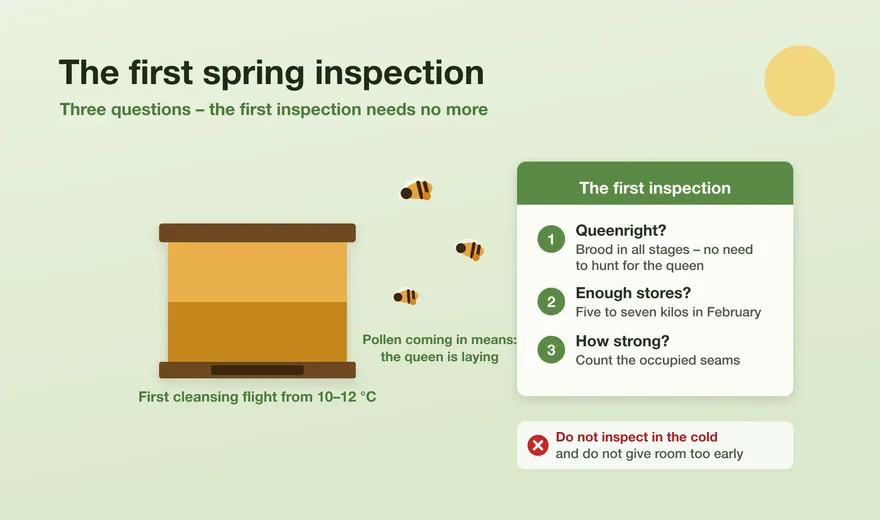
The first inspection tells you which colonies will get away. Open too early or search too thoroughly and you do more damage than you gain in knowledge – when most of it can be read from the outside.
After the first warm day in February your fingers itch. Understandable – after months of waiting you want to know what became of your colonies. But every opening costs the colony heat, and in February it has none to spare. The good news is that most of what you need does not require opening at all.
What you can read without lifting the lid
Watch the entrance. The first cleansing flight shows at a glance which colonies are alive and how strong they are. A colony that sends out a hesitant handful at 12 °C while its neighbour roars has a problem. Bees carrying pollen are the best sign of all: pollen only goes in when there is brood – and brood means the queen is laying.
Read the debris. The inspection tray is your most useful tool in spring. The cappings show you how many seams the colony occupies and how large the brood nest is. The traces shift week by week – that is how you see the nest expanding.
Check the weight. Tilt the hive slightly from the back. With a little practice you can feel whether stores remain. It takes seconds and disturbs nothing.
Look at the dead bees. A few hundred in front of the entrance is normal. What stands out is extended tongues – starvation despite stores, because the cluster lost contact with the food – or faecal spotting on the front wall.
When you may open
Wait for a calm day of at least 10 to 12 °C, ideally around midday with bees flying. Depending on the region that means late February to mid-March. A cool, breezy day is not a compromise, it is a bad idea – chilled brood dies.
Three questions, nothing else
The first inspection is not a stocktake. You answer three questions and put the lid back on.
1. Is the colony queenright? You do not need to see the queen for that. Find brood in all stages – eggs, young larvae, sealed brood – and she is laying. That is enough. Hunting for the queen only costs time and warmth.
If you find only sealed brood and no eggs, the queen has failed or stopped. If you find several eggs per cell and domed cappings on worker cells, you have a drone-laying colony – nothing will fix that, the colony gets shaken out.
2. Are there enough stores? This is the most common cause of spring losses – and the most avoidable. Consumption jumps once brood rearing starts. A colony sitting on three kilos in February can starve in March having survived the whole winter. As a rule of thumb you want to find five to seven kilos in February.
If it is short, give fondant directly above the cluster. Syrup is a poor choice at these temperatures – the bees can barely take it and it invites robbing.
3. How strong is the colony? Count the occupied seams. You need that number later to decide when to give more room – and in autumn to understand why some colonies did better than others.
What not to do now
- Go through comb by comb. At ten degrees every brood comb you lift is a risk.
- Break up the brood nest. Rearranging can wait.
- Give room too early. A colony that cannot occupy the extra space chills. Expand when the existing combs are covered.
- Search for the queen. As above – brood stages tell you the same in a fraction of the time.
Floors and varroa
The first inspection is a good moment to clean or swap the floor. Clearing out dead bees and debris costs nothing and removes a food source for wax moth and mould.
The spring mite drop also tells you how well your winter treatment worked. A heavy drop now means you need to act earlier and harder come summer.
Write it down while you are standing there
Colony strength, stores, queenrightness – three notes per colony that you will not be able to reassemble in May if you skip them now. Record them for two springs and by the third you start seeing patterns: which sites carry, which queens start early, which colonies are regularly short of food.
How to get colonies through the winter so there is something to find in spring is covered in our wintering checklist.
Three notes per colony nobody can reassemble in May
Colony strength, stores and queenrightness, recorded at the apiary. After two springs you can see which queens start early and which sites carry.
Record inspections digitallyFrequently Asked Questions
At what temperature can I open a colony in spring?
From about 10 to 12 °C on a calm day, ideally at midday with bees flying. Below that, brood chills. Keep the inspection short and stick to queenrightness, stores and colony strength.
How do I tell the colony is queenright without opening it?
By the pollen going in: bees with full pollen baskets mean brood is being fed – and therefore that the queen is laying. You confirm it at the first inspection by finding brood in all stages. You do not need to find the queen herself.
How much food does a colony still need in February?
Five to seven kilos as a rule of thumb. Consumption rises sharply once brood rearing begins, which is why colonies starve in March rather than January. If stores are short, place fondant directly above the cluster.
 Organic cotton beekeeper T-shirt “The Dance Language”