
Beekeeping knowledge
Winter bees: why late-summer care decides the winter
Winter bees are the real heroes of the bee year: they live months instead of weeks and carry the colony through the cold. Whether they grow up healthy is decided in late summer. We explain why — and what it means for your colony care.
When we speak of the "colony in winter", we mean a very special generation: the winter bees. They differ fundamentally from summer bees — and whether they are healthy decides life and death for the colony in the cold season. The remarkable thing: their fate is sealed already in late summer, long before the first frost.
What makes winter bees so special
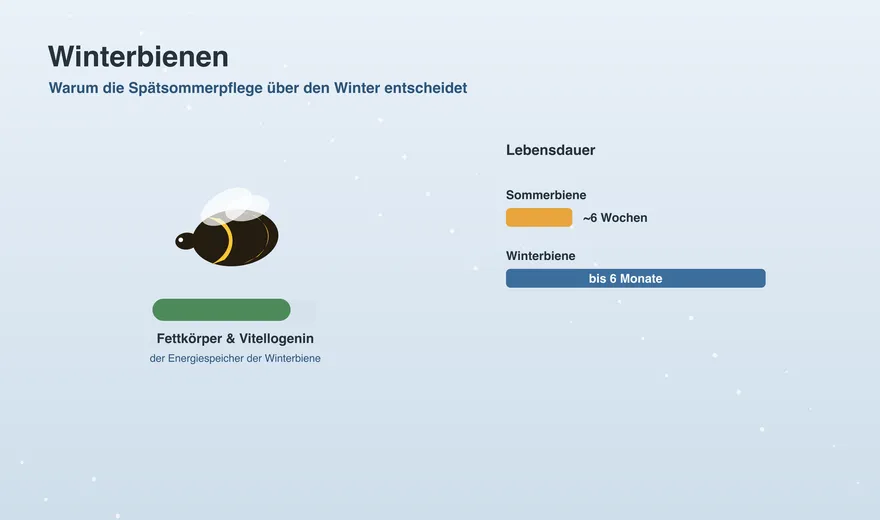
A summer bee lives only about six weeks — it literally works itself to death in the foraging season. A winter bee, by contrast, lives up to six months. This is made possible by a completely different metabolism: winter bees form a large fat body and in it plenty of vitellogenin, a storage protein. Vitellogenin suppresses an ageing hormone, strengthens the immune system and serves as a protein reserve. This is exactly why these bees survive the long, broodless winter months and raise the first new brood in spring.
How winter bees are formed
Winter bees grow up in late summer and autumn. To build their large fat body, they need two things: sufficient protein (pollen) and a healthy, low-stress environment. A colony that is well supplied now and does not suffer from mites forms strong, long-lived winter bees. A stressed colony forms weak ones — and they do not make it.
The varroa connection
Here the circle closes back to varroa treatment. The varroa mite feeds on the fat body of larvae and pupae — exactly the tissue that makes the winter bee so valuable. It taps the vitellogenin reserves and weakens the immune system. A single mite can shorten a winter bee's lifespan by around 30 percent. A colony with a high mite load therefore forms sick winter bees, even if there is enough feed — and collapses in winter, even though everything looked healthy in autumn.
What this means for your late-summer care
From this biology follows the most important rule of the season directly: the varroa treatment in late summer is not a side issue but the life insurance of your winter bees. Whoever reduces the mites in good time after extraction protects exactly the generation that has to carry the colony through winter. Three things therefore belong together:
- Timely varroa treatment right after the last harvest, so the winter bees grow up low in mites.
- Good protein supply — a colony with access to pollen forms stronger winter bees.
- Enough feed, so the colony does not have to raise the winter bees at the expense of its reserves.
Conclusion
Winter bees are formed not in winter, but in late summer. Whoever ensures a low mite load, good protein supply and enough feed now lays the foundation for a strong spring. Late-summer care is thus perhaps the most important switch of the whole bee year.
Document inspections without having to think about it
You record the date, product, amount and the treated colonies right at the apiary. The basis for your medicine record book builds up as you go.
Start for freeFrequently asked questions
Why do winter bees live so much longer than summer bees?
Because they form a large fat body with plenty of vitellogenin. This storage protein suppresses an ageing hormone and strengthens the immune system, so winter bees live up to six months instead of only six weeks.
What does varroa have to do with the winter bees?
The varroa mite feeds on the fat body and uses up the vitellogenin reserves. A single mite can shorten a winter bee's lifespan by around 30 % — which is why the late-summer treatment is so important.
When are the winter bees formed?
In late summer and autumn. That is why the care in this period — low mite load, good pollen supply and enough feed — decides the success of the wintering.
 Organic cotton beekeeper T-shirt “The Dance Language”