
Beekeeping knowledge
Beekeeping and tax: what hobby beekeepers should know
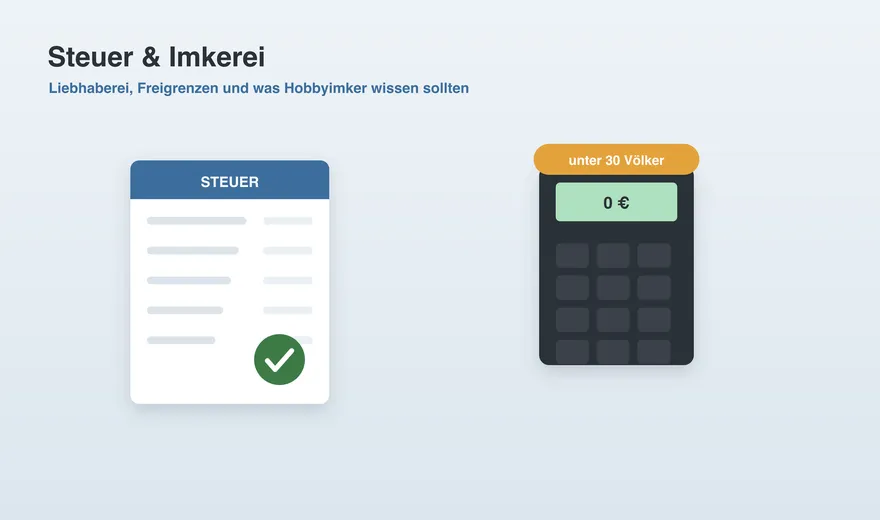
As soon as the first honey is sold, the question of tax comes up. The good news: for most hobby beekeepers this is relaxed. We explain the key rules for Germany — clearly and without jargon.
Hardly any topic unsettles aspiring beekeepers as much as tax. Do I have to tax the sale of my honey? Do I become a business? The reassuring answer up front: for the typical hobby apiary, almost everything stays in the clear for tax. We explain why — and when it does become relevant. Please note: this is general guidance, not tax advice, and refers to Germany.
Income tax: the 30-colony threshold
Beekeeping counts as agriculture for tax. For small apiaries there is a very pleasant rule: with fewer than about 30 colonies, the profit is effectively set at 0 euros under the flat-rate averages. In practice this means: you pay no income tax on your honey sales — regardless of how many jars you sell.
Hobby status: a hobby without profit intention
A second term that often comes up is the German concept of "Liebhaberei" (hobby status). By this the tax office means an activity carried out without the intention of making a profit — out of enjoyment. A small hobby apiary that barely generates surpluses is often classified this way. Then, too, no income tax applies.
VAT: small business or flat rate
For VAT there are two paths. Anyone below the small-business threshold charges no VAT and pays none — which applies to the vast majority of hobby beekeepers. Alternatively, agricultural operations can use the flat-rate scheme. Which path is cheaper depends on the individual case.
When does it become relevant after all?
The topic gets more serious when you grow beyond the 30-colony threshold, mainly resell bought-in honey or generate larger turnover. Then bookkeeping obligations, a trade licence and tax liabilities can arise. At the latest then, an appointment with a tax adviser is worthwhile.
Our tip
Keep clean records of your income and expenses — even if you pay no tax. That gives you an overview, and if the tax office does ask, you can provide information. If your apiary grows, get professional advice early. That way the hobby stays a hobby and does not become a tax trap.
Document inspections without thinking about it
Record date, product, amount and the treated colonies right at the apiary. The basis for your treatment records builds itself as you go.
Start for freeFrequently Asked Questions
Do I have to tax my honey as a hobby beekeeper?
Usually not. With fewer than about 30 colonies the tax office effectively sets the profit at 0 €, so no income tax applies. VAT usually does not apply under the small-business rule.
What does hobby status (Liebhaberei) mean in beekeeping?
The tax office classifies an activity without profit intention as hobby status. Small hobby apiaries often fall under this — then honey sales are irrelevant for income tax.
When do I have to worry about tax?
Once you grow beyond about 30 colonies, mainly resell foreign honey or make larger turnover. Then trade and tax obligations can arise — a tax adviser can help.
 Organic cotton beekeeper T-shirt “The Dance Language”