
Beekeeping knowledge
Neonicotinoids 2026: where does the ban stand — and what does it mean for bees?
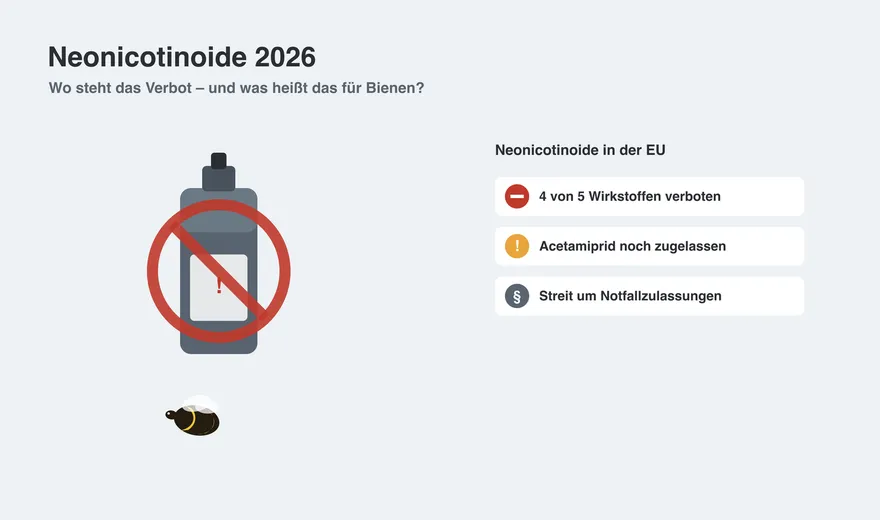
Neonicotinoids are considered one of the main causes of insect decline. In the EU most are now banned — but the debate continues. We give a factual overview of the 2026 status and what it means for bees.
Hardly any group of active substances is discussed as controversially as the neonicotinoids. These insecticides act on the nervous system of insects even in the smallest amounts — and thus also on bees. For years they were suspected of contributing to the decline of bees and wild insects. Where does the ban stand today, in 2026? We assess the current status factually.
What is banned
The EU has acted step by step: since 2018, the outdoor use of the three neonicotinoids clothianidin, thiamethoxam and imidacloprid in agriculture has been banned EU-wide. In 2020, thiacloprid also lost its approval. That means four of the five classic neonicotinoids have disappeared from the market. First studies already show an effect: the documented exposure of bees to these three substances has clearly declined — good news.
What is still approved
One substance has remained: acetamiprid. It is considered less harmful to bees than its relatives and is, as things stand, approved in the EU until 2033. However, acetamiprid too is not uncontested: because of elevated residues in food, the EU has recently lowered limit values, and environmental groups call for stricter rules. Its outdoor use in Germany has recently even increased.
The dispute over emergency authorisations
A particularly contested chapter is the so-called emergency authorisations. With these, individual countries can temporarily allow banned agents under conditions after all — for example in sugar-beet growing. Critics regard this as a hollowing-out of the ban; courts have already declared several such authorisations inadmissible. In France, too, a loosening of the national ban is being discussed. The legal situation is thus in flux.
What this means for beekeepers and bees
For us beekeepers the development is largely positive: the most dangerous neonicotinoids have disappeared from outdoor use, and the measurable exposure of bees has fallen. At the same time, the debate around acetamiprid and emergency authorisations shows that the topic is not settled. For your own apiary, as always: good site selection, contact with the farmers in the area and an eye on what is applied around the forage within flight range. Anyone who suspects poisoning should secure samples and involve the responsible testing body.
Conclusion
The trend clearly points towards stricter rules — four of five neonicotinoids are already history. But with acetamiprid and the emergency authorisations, a remainder stays that is still being fought over. Plant protection is a moving field; the current rules can change, which is why it is worth keeping an eye on the announcements of the authorities and beekeeping associations.
Document inspections without thinking about it
Record date, product, amount and the treated colonies right at the apiary. The basis for your treatment records builds itself as you go.
Start for freeFrequently Asked Questions
Are neonicotinoids banned in the EU?
Four of the five classic neonicotinoids are banned: clothianidin, thiamethoxam and imidacloprid outdoors since 2018, thiacloprid since 2020. Only acetamiprid is currently still approved.
Why is acetamiprid still allowed?
Acetamiprid is considered less harmful to bees and is, as things stand, approved in the EU until 2033. It remains contested, though — the EU has lowered limit values because of residues in food.
What are emergency authorisations?
Temporary exceptions with which countries can allow banned agents under conditions after all. They are highly contested, and courts have declared several of them inadmissible.
 Organic cotton beekeeper T-shirt “The Dance Language”