
Beekeeping knowledge
Selling honey as a hobby beekeeper: registration, label and tax
Want to sell your honey? It is easier than many think – but you should know a few rules. We walk step by step through what you have to register, what belongs on the label and how it works for tax. All details refer to Germany.
What should your honey cost?
Enter material, working time and overheads per jar: the calculator gives you a selling price that does not leave you out of pocket.
To the honey price calculatorThe first jars of your own honey are ready – and neighbours, friends or the local market are already asking. The good news: any beekeeper may sell honey, including as a hobby. You need neither found a company nor fight through mountains of paperwork. But you should know a few ground rules so you stay on the safe side legally. We have summarised them here in a practical way.
Do I need a trade licence – or is registering as a food business enough?
Let us start with the most common worry: no, you usually need no trade licence. Selling your own honey counts as agricultural primary production and is therefore exempt from trade licensing. Only when you mainly buy in and resell someone else's honey does the hobby turn into a trade – and then a licence is due.
There is one thing you must do as soon as you hand honey to others: register as a food business operator. That sounds bigger than it is. An informal, free notification to the food safety or veterinary authority of your district is enough. A short call or e-mail usually clarifies which form your authority wants. The background is the European food hygiene regulation: anyone placing food on the market should be on the authority's radar – regardless of whether you have two colonies or twenty.
What has to go on the label?
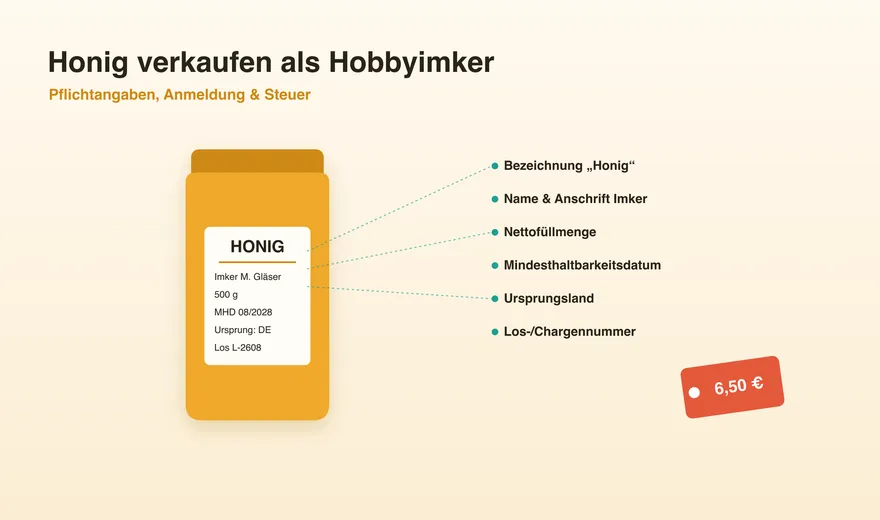
Honey is one of the most clearly regulated foods. The basis is the German Honey Regulation and the European Food Information Regulation (LMIV). Every jar you sell must carry these mandatory details:
- the name "honey" – with the variety if you like (e.g. "blossom honey" or "lime honey"). You must be able to substantiate variety claims.
- name and address of the beekeeper or responsible person – a PO box is not enough, it must be a proper address.
- net quantity in grams or kilograms (e.g. 500 g).
- best-before date. Two years is common for honey, provided it is stored cool and dark.
- lot/batch number so a batch can be traced. It may be dropped if the best-before date includes the day – with the month-only date common for honey, you therefore need it.
- country of origin in which the honey was produced.
Important for origin: since 14 June 2026, blended honey must list all countries of origin with their percentage share. For your single-origin German honey, "Germany" is still enough. You will find the details in our article on the new honey labelling. No nutrition table is required for honey – as an unprocessed product it is exempt.
A small practical tip: make sure everything is easy to read (minimum font size) and that details are not hidden by the lid or seal. If you are a member of a beekeeping association, you can additionally use the well-known guarantee jar – but it is not mandatory.
How does it work for tax?
For the vast majority of hobby beekeepers this is more relaxed than expected:
- Income tax: beekeeping operations with fewer than about 30 colonies effectively set their profit at 0 euros under the flat-rate averages. In practice, no income tax applies – no matter how many jars you sell. Often the tax office classifies a small apiary as a "hobby" without profit intention anyway.
- VAT: anyone below the small-business threshold charges no VAT and pays none. Alternatively, the flat-rate scheme for farmers applies.
These thresholds and rates are adjusted occasionally and depend on the individual case. So treat this as guidance, not tax or legal advice. As soon as things get concrete or you grow, a short call to the tax office or an appointment with a tax adviser is worthwhile – it costs little and saves trouble.
Work cleanly and document
No matter how small you start: only sell sound, ripe honey. The water content should be below 18 % so the honey does not ferment – a refractometer therefore belongs to the basic equipment. Keep your tools clean, bottle hygienically and note which batch is in which jar. It is exactly this traceability that food law requires – and it is your best protection if something goes wrong. The easiest way to keep these records is digitally, together with harvest and treatments.
Three steps to legal honey sales
In short: first, the informal notification as a food business operator to the food authority. Second, label correctly. Third, bottle and document cleanly. If you follow these three points, nothing stands in the way of selling your honey.
Document inspections without thinking about it
Record date, product, amount and the treated colonies right at the apiary. The basis for your treatment records builds itself as you go.
Start for freeFrequently Asked Questions
Do I need a trade licence to sell honey as a hobby beekeeper?
Usually not: selling your own honey is exempt from trade licensing as agricultural primary production. You do have to register as a food business operator with the food safety authority – this is free and informal.
What information must appear on the honey jar?
The name "honey", the beekeeper's name and address, net quantity, best-before date, lot/batch number and country of origin. For blended honey, since June 2026, all countries of origin with their percentage.
Do I have to pay tax on selling honey?
Small hobby apiaries usually pay no income tax – with fewer than about 30 colonies the profit is effectively set at 0 euros. VAT normally does not apply under the small-business rule. This is not tax advice; ask your tax office or adviser when in doubt.
 Organic cotton beekeeper T-shirt “The Dance Language”