
Beekeeping knowledge
Varroosis is now a notifiable disease – what applies to beekeepers since March 2026
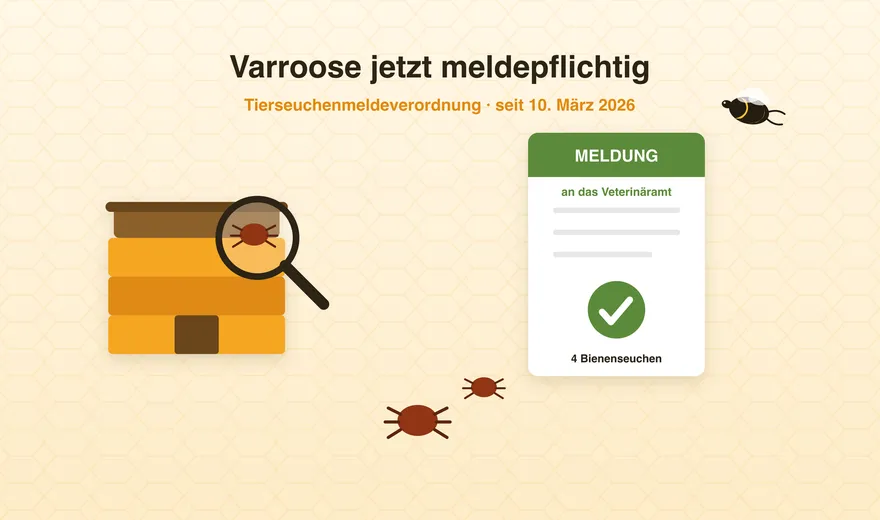
Since 10 March 2026, varroosis has formally been a notifiable disease in Germany. We explain what the new animal-disease reporting regulation covers – and why many beekeepers still don't have to report anything.
On 10 March 2026, the new German animal-disease reporting regulation (Tierseuchenmeldeverordnung, TierSeuchMeldV) came into force. It defines, nationwide, which animal diseases must be reported to the authorities – and for us beekeepers it brings an important change: varroosis, the infestation with the varroa mite, has for the first time been explicitly added to the list of notifiable bee diseases.
Four notifiable bee diseases
Under the new regulation, four bee diseases are notifiable:
- American foulbrood (Paenibacillus larvae),
- infestation with the small hive beetle (Aethina tumida),
- infestation with Tropilaelaps mites (Tropilaelaps spp.), and
- new: infestation with varroa mites (varroosis).
The report goes to the responsible veterinary office and is forwarded from there through the official animal-disease notification system. Its main purpose is national statistics and an overview of the disease situation – unlike the long-standing duty to notify for American foulbrood, which triggers concrete control measures.
Why many beekeepers still don't have to report anything
At first glance this sounds like extra bureaucracy for every beekeeper. In practice it usually isn't. The varroa mite is widespread across Germany – practically every colony is infested, and even consistent treatment does not produce mite-free colonies.
For exactly this reason, several federal states – including Lower Saxony and Hesse – have decided that a report of varroosis by beekeepers is unnecessary. The reasoning: since a widespread infestation can be assumed anyway and all beekeepers are already registered with the animal-disease fund, an individual report adds no further insight.
Important: this exemption is regulated at state level and can differ from one federal state to another. For the three other diseases – foulbrood, hive beetle and Tropilaelaps – the reporting obligation remains fully in place.
What you should actually do
In practice this means: check once with your responsible veterinary office or your regional beekeeping association how your area handles varroosis reporting. In most federal states you don't need to do anything about the mite. If you suspect foulbrood, hive beetle or Tropilaelaps, however, inform the veterinary office immediately.
The new regulation changes nothing about your actual beekeeping work. Regular monitoring of mite levels and consistent, timely varroa treatment in late summer remain the be-all and end-all for healthy colonies – regardless of the reporting obligation.
Source
Regulation on the reporting of animal diseases (Tierseuchenmeldeverordnung – TierSeuchMeldV), in force since 10 March 2026 (BGBl. 2026). Guidance from state authorities on its application, including the Lower Saxony State Office for Consumer Protection and Food Safety (LAVES) and the Regional Association of Hessian Beekeepers.
Document inspections without thinking about it
Record date, product, amount and the treated colonies right at the apiary. The basis for your treatment records builds itself as you go.
Start for freeFrequently Asked Questions
As a beekeeper, do I now have to report a varroa infestation?
In most federal states, no. Varroosis has been formally notifiable since 10 March 2026, but states such as Lower Saxony and Hesse consider reporting by beekeepers unnecessary because practically all colonies are infested. When in doubt, ask your veterinary office or regional association.
Which bee diseases have been notifiable since 2026?
Four: American foulbrood, the small hive beetle, Tropilaelaps mites and – new – varroosis. If you suspect the first three, you must inform the veterinary office immediately.
Does the reporting obligation change anything about varroa treatment?
No. Regular mite monitoring and consistent treatment in late summer remain just as important. The reporting obligation is a purely administrative rule and does not replace any beekeeping measure.
 Organic cotton beekeeper T-shirt “The Dance Language”