
Beekeeping knowledge
Pollen-replacing feed halves winter losses – what the new long-term study shows
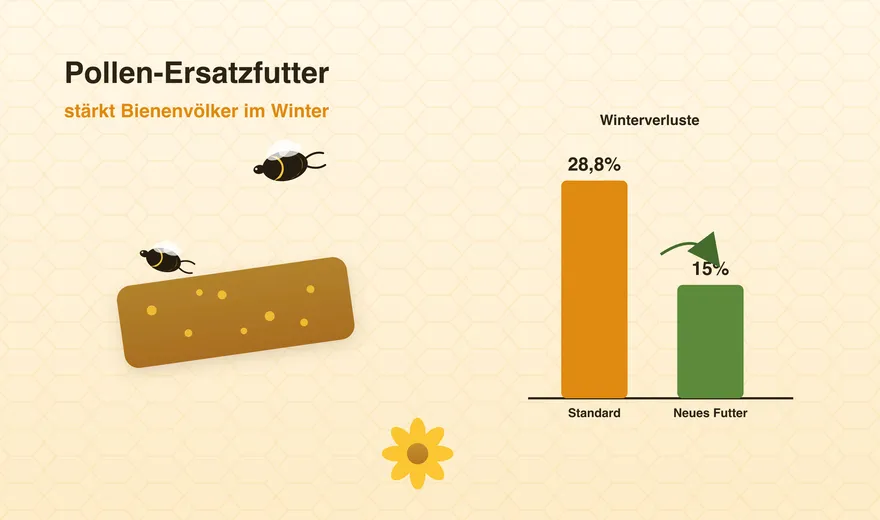
A new long-term study from the USA shows that a nutritionally complete pollen-replacing feed can nearly halve winter losses in bee colonies. We put the results into perspective for practice.
Pollen is the most important protein source for a bee colony – without it, the nurse bees lack the building material for healthy winter bees. Yet in many intensively farmed landscapes a good pollen supply is becoming scarce. A research team at Washington State University (WSU), together with the Belgian company APIX Biosciences, has now tested a nutritionally complete pollen-replacing feed in practice over two winters – with remarkable results.
Winter losses nearly halved
Five commercial beekeepers in California and Idaho fed their colonies the new feed from autumn 2022 to spring 2024. The key result: winter losses fell from 28.8 percent (with conventional commercial feeding) to 15 percent – almost a halving.
The condition of the surviving colonies was also considerably better. In January, the fed colonies had more adult bees and more brood. After the exhausting almond-pollination in March, they emerged from the deployment with around 36 percent more bees and 40 percent more brood than the comparison colonies.
The secret: the right sterols
The feed resembles an oversized, very thin granola bar and was developed over around ten years. The decisive breakthrough lay in the sterols – fat-like building blocks that bees normally obtain solely from pollen. In accompanying research, the sterol isofucosterol in particular proved critical: without it, the bees' brood development and nervous system suffered. The replacement feed supplies these substances specifically, making the colony less dependent on the natural pollen flow.
Putting it in context for beekeeping in Germany
The right context matters: the study comes from US commercial beekeeping, where tens of thousands of colonies are transported over long distances for almond pollination and often have to get by for weeks without natural pollen sources. In this extreme situation the feed shows its greatest benefit.
For most beekeeping operations in Germany the rule is: where sufficient natural pollen flow is available, real pollen remains the best nutrition – a replacement feed is no substitute for good forage conditions and a bee-friendly environment. The research is nonetheless interesting because it demonstrates a genuinely complete replacement feed for the first time and sharpens our understanding of bee nutrition considerably. When and whether the product will be widely available in Europe remains to be seen.
Source
Washington State University Honey Bee Program & APIX Biosciences (2026): long-term study on the effect of a pollen-replacing feed on colony strength over two winters, published in the journal Insects. On the significance of the sterol isofucosterol: Proceedings of the Royal Society B (2025).
Document inspections without thinking about it
Record date, product, amount and the treated colonies right at the apiary. The basis for your treatment records builds itself as you go.
Start for freeFrequently Asked Questions
How much does the pollen-replacing feed reduce winter losses?
In the study, winter losses fell from 28.8 percent with conventional feeding to 15 percent with the new feed – almost a halving.
What makes the new bee feed special?
It is a nutritionally complete pollen-replacing feed that specifically contains the sterols bees otherwise only get from pollen. The sterol isofucosterol in particular proved crucial for brood and health.
Should I now feed my bees a replacement feed?
Where there is enough natural pollen flow, real pollen remains the best food. The replacement feed shows its benefit mainly in US commercial beekeeping under pollen shortage and is not yet widely available in Europe.
 Organic cotton beekeeper T-shirt “The Dance Language”