
Beekeeping knowledge
New study: honey bees navigate with centimetre precision – more precise than the waggle dance
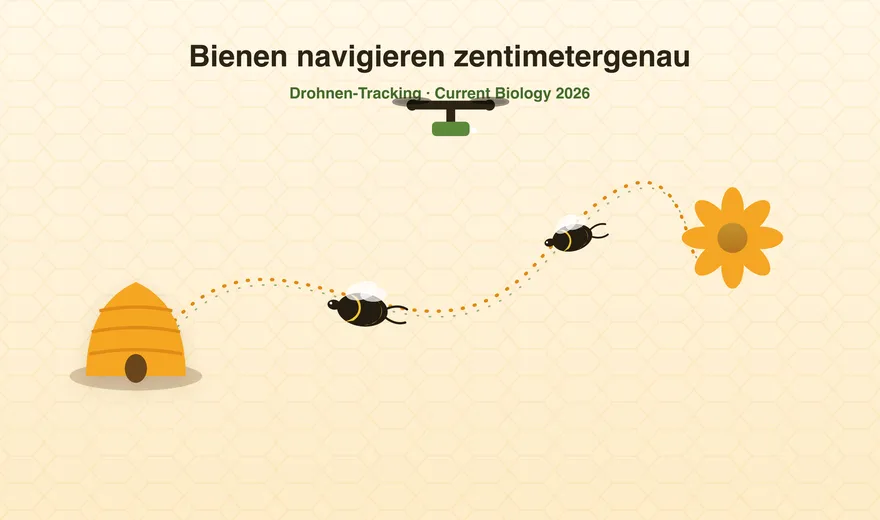
A research team at the University of Freiburg tracked honey bees in flight using drones. The surprising result: every bee has its own route – and hits it again and again to within centimetres.
That honey bees perform astonishing feats of navigation is well known. But exactly how a single bee finds its way between the hive and a food source could barely be measured in the field until now. A team at the University of Freiburg led by Prof. Andrew Straw has managed to do just that – with an unusual method.
Tracking bees by drone
The researchers attached tiny reflective markers to individual foraging bees. A drone equipped with a camera and image processing then automatically tracked the animals in flight and recorded high-resolution 3D flight paths in a natural environment. In total, they analysed 255 flight paths between the hive and a food source around 120 metres away.
Every bee flies its own route
The central finding: each bee develops a completely individual flight route – and repeats it across several flights with astounding precision. Consecutive flights often lay only a few centimetres apart, both on the outbound and the return journey.
How precisely the bees flew depended on the landscape. Near striking landmarks – such as a single tree – the deviations were smallest. Over monotonous areas like a maize field, where reference points are missing, the routes scattered more widely. This suggests the animals deliberately orient themselves by prominent points in the landscape.
More precise than the waggle dance
The comparison with the famous bee language is especially interesting. Through the waggle dance, foragers tell their hive mates the direction to a food source – but only roughly, with a directional error of around 30 degrees. The actual flight precision of the individual bee thus clearly exceeds this accuracy. The dance apparently provides the rough direction, while each bee learns the finely tuned route individually.
What this means for us beekeepers
For everyday beekeeping the study has no immediate consequences – but it once again shows how capable our bees' sense of orientation is. It also explains why moving a hive throws foragers into such disarray: if a colony is moved just a few metres, the experienced foragers first return to the old, precisely memorised spot. The finding is a reminder of the fine-tuning with which a bee colony uses its surroundings.
Source
Stentiford, R., Straw, A. D. et al. (2026). Precise, individualized foraging flights in honeybees revealed by multicopter drone-based tracking. Current Biology. DOI: 10.1016/j.cub.2026.01.045. University of Freiburg.
Document inspections without thinking about it
Record date, product, amount and the treated colonies right at the apiary. The basis for your treatment records builds itself as you go.
Start for freeFrequently Asked Questions
How precisely do honey bees fly their route?
According to the Freiburg study, individual bees repeat their individual flight path across several flights to within a few centimetres – both on the outbound and the return journey.
How were the bees tracked in flight?
The researchers attached tiny reflective markers to the bees and tracked them with a camera-equipped drone that automatically recorded high-resolution 3D flight paths.
Is the flight more precise than the waggle dance?
Yes. The waggle dance conveys direction only roughly, with about 30 degrees of error. The actual flight precision of the individual bee is much higher – it additionally orients itself by landmarks.
 Organic cotton beekeeper T-shirt “The Dance Language”